Tearing down a house in Sacramento is a project that requires careful planning, proper permitting, licensed contractor involvement, and systematic execution across multiple phases. Whether the goal is clearing a lot for new construction, removing a home damaged beyond repair, eliminating a blight property, or repurposing a residential lot for a different use, the house demolition process in Sacramento follows a consistent regulatory and operational framework. This guide walks through everything property owners in Sacramento need to understand about House Demolition Sacramento before engaging a contractor.
House Demolition vs. Deconstruction in Sacramento
When a Sacramento home needs to come down, property owners have two primary approaches to choose from: conventional mechanical demolition and deconstruction. Mechanical demolition uses an excavator to efficiently break apart and remove the structure, typically completing the physical work in one to three days. Debris is loaded into trucks and hauled to disposal or recycling facilities. This approach is fast and cost-effective.
Deconstruction is a manual, labor-intensive alternative that disassembles the structure by hand to preserve reusable materials dimensional lumber, hardwood flooring, windows, doors, cabinetry, plumbing fixtures, and architectural elements. Deconstructed materials can be donated to organizations like the Sacramento ReBuilding Materials Center or other salvage operations, with potential tax deductions for donated material. Deconstruction takes significantly longer than mechanical demolition sometimes weeks for a complete house and is generally more expensive due to the labor intensity. It is most commonly chosen when the home contains high-value salvageable materials or when the property owner has strong environmental objectives.
Pre-Demolition Steps for a Sacramento House Teardown
A Sacramento house demolition begins well before the first piece of equipment arrives on site. The sequence of required preparatory steps includes: (1) asbestos and lead paint survey by a certified inspector; (2) asbestos abatement if regulated materials are found; (3) utility disconnections coordinated with PG&E, SMUD (for Sacramento city electric customers), and the applicable water and sewer utility; (4) demolition permit application through the City of Sacramento Development Services Department or Sacramento County; and (5) notification to adjacent property owners where required.
The asbestos survey step is particularly important given Sacramento’s housing stock. The Sacramento region has substantial quantities of housing built between 1930 and 1980 a period when asbestos was routinely incorporated into residential construction materials. Floor tile (vinyl asbestos tile or VAT), ceiling tile, textured ceiling coatings, roofing felt, pipe insulation in older homes with forced air or radiant heat systems, and joint compound are all common asbestos-containing materials in Sacramento homes of this era. The SMAQMD requires that regulated asbestos be properly abated before demolition contractors can face significant fines for demolishing structures with unabated asbestos.
Utility disconnection is the final safety prerequisite. PG&E and SMUD disconnect electrical service at the meter; PG&E caps natural gas at the meter. The City of Sacramento or local water utility caps water and sewer service at the property line or curb. In Sacramento’s older neighborhoods particularly in the grid neighborhoods east of downtown and the established suburbs of Arden-Arcade utility infrastructure can be complex, with older service connections that require careful coordination to properly decommission.
The Physical House Demolition Process
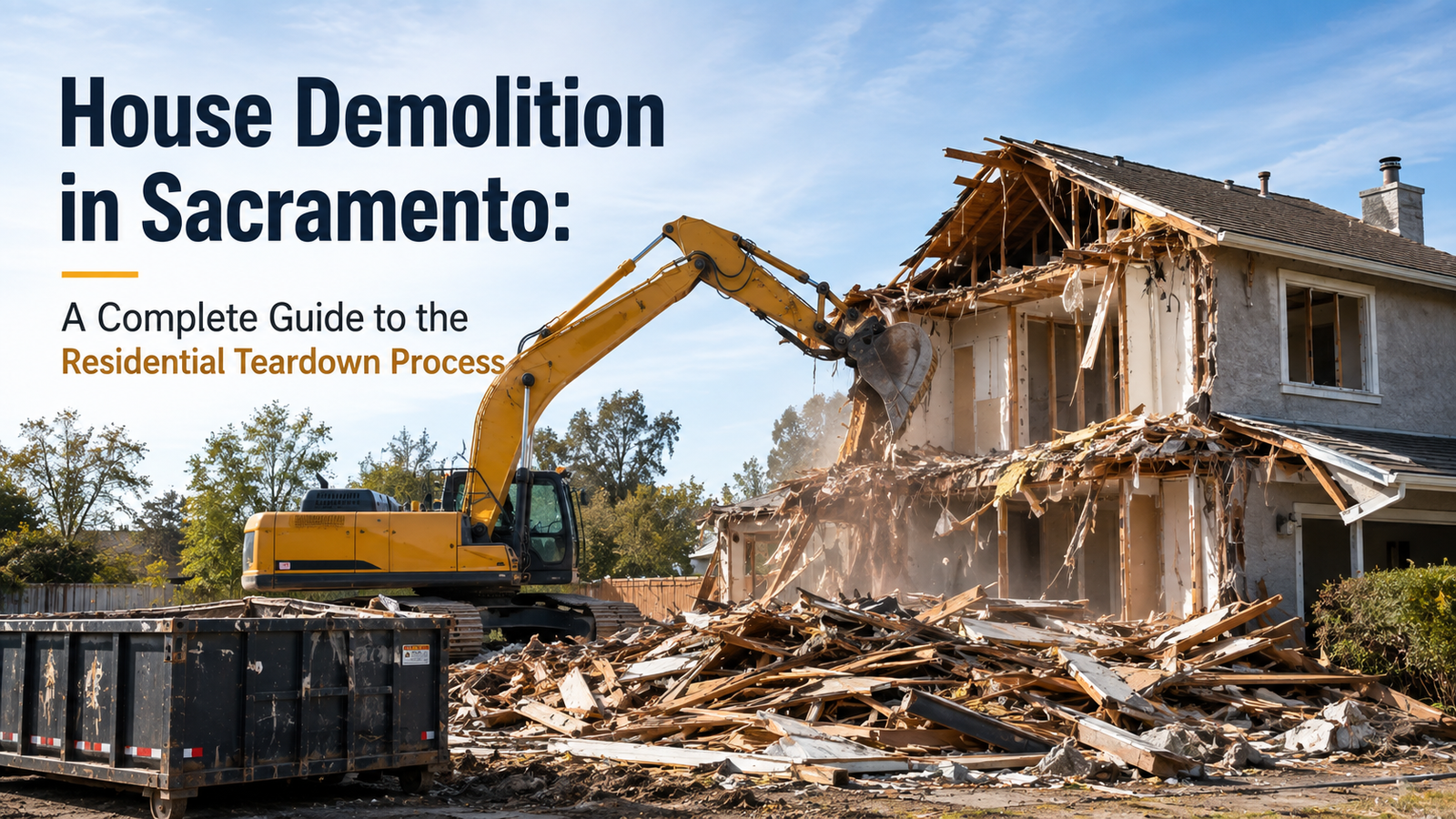
With permits issued, hazardous materials abated, and utilities confirmed disconnected, physical demolition begins. For a typical Sacramento wood-frame single-family home, a 20-to-30-ton excavator is the primary tool. The operator works systematically, beginning with the roof structure and working downward through the wall framing, floor systems, and finally the foundation. The excavator arm and bucket control the pace and direction of demolition, allowing the operator to break material into manageable sections and load trucks continuously.
Sacramento’s hot, dry summers with temperatures regularly exceeding 100°F in July and August create specific operational considerations for house demolition. Dust suppression through water misting is particularly important during Sacramento’s dry season, when demolition activity can generate significant particulate that disperses widely in dry, windy conditions. Active dust suppression protects neighbors and complies with SMAQMD’s dust control requirements.
Sacramento’s tree ordinances add a layer of planning for house demolitions in established neighborhoods. The City of Sacramento’s Protected Tree Ordinance protects trees of certain species and size classes within the city limits, requiring permits before removal and imposing replacement requirements. In neighborhoods with mature tree canopies the Fab 40s, Elmhurst, Land Park, and others demolition contractors must plan equipment movement and debris management routes to protect designated trees adjacent to the demolition site.
Foundation Options After House Demolition in Sacramento
After the above-grade structure is demolished and debris cleared, the property owner makes a decision about the foundation. Two primary options exist: retain the existing foundation for reuse, or remove it completely.
Foundation retention may be viable when the new construction will use the same or similar footprint and the existing foundation is structurally sound. However, Sacramento’s soil conditions introduce significant risk: the expansive clay soils characteristic of the Sacramento Valley can cause differential movement in foundations over time, and a foundation that appears adequate may have hidden settlement or soil issues that would compromise new construction built on it. Geotechnical evaluation of the existing foundation before deciding to retain it is strongly advisable.
Full foundation removal is standard practice when complete site clearance is the goal and when new construction will be designed with a fresh foundation. Foundation concrete is broken with hydraulic breakers and hauled to Sacramento-area recycling facilities for crushing into RCA. The excavation is backfilled with engineered fill material, compacted in lifts to at least 90% of maximum density per ASTM D1557, and graded to establish proper drainage before the site is considered cleared and ready for new construction.
Common Questions About House Demolition in Sacramento
How do I find a licensed demolition contractor in Sacramento? The CSLB website at cslb.ca.gov allows license verification by contractor name or license number. Look for contractors with current C-21 or General B licenses, active general liability and workers compensation insurance, and verifiable project history in the Sacramento area.
What is the Sacramento demolition permit timeline? Permit processing for residential demolition in Sacramento typically takes two to four weeks for standard applications. Applications involving older structures requiring asbestos clearance documentation may take longer. Experienced contractors who regularly work with Sacramento’s Development Services Department understand how to submit complete applications that minimize review delays.
What happens to the cleared lot after house demolition? The lot is graded to establish positive drainage, erosion control is installed if needed, and the site is left in condition for its intended next use new construction preparation, landscaping, or other planned purposes. The City of Sacramento requires that demolition sites be maintained to prevent nuisance conditions from developing on cleared lots awaiting redevelopment.